A strong foundation.Freedom to play.
Read the music, hear the sound, express it in your own way.Open up your world of music with Soo Piano.
Soo Piano · Sydney
Looking for adult or worship piano lessons?How our lessons workOUR APPROACH
Your child’s first piano lessons —where do you begin?
Listening, reading and playing,so they understand the music.
We build playing fundamentals at your child’s level and use what they learn inside real pieces. Connecting notation with sound and experiencing rhythm and chords, they grow the ability to express music on their own.
Listening and reading to build playing fundamentals.
Children hear the sound, feel the rhythm and connect the notation to the keys — along with a comfortable posture and natural hand movement.
Bringing rhythm and chords into pieces.
In pieces that suit their level, they explore how rhythm and chords are used, connecting melody and accompaniment to understand and play music themselves.
Playing musically from the very start.
Even in a short melody, they feel the dynamics and flow of the sound — thinking about the mood of the piece and refining their expression by listening to their own playing.
YOUR CHILD’S MUSICAL JOURNEY
From the very first note,to a musical voice of their own.
Technique, reading, listening and creative expression grow together from the start, at your child’s level.
STAGE 1
Discover
Posture, note names, rhythm and reading from one hand to both
STAGE 2
Develop
Stronger reading, basic harmony, ear training, rhythmic expression and simple chord accompaniment
STAGE 3
Explore
Writing simple melodies, copying songs by ear, analysing pieces, understanding each instrument and chord progressions
STAGE 4
Express
Chord and rhythm arranging, solo playing, playing in a band and techniques for each instrument
Five abilities that grow at every stage
Technique
Posture, touch and hand independence
Reading & Theory
Reading, time signatures and keys
Ear & Rhythm
Listening, rhythm and playing by ear
Repertoire & Performance
Playing pieces, interpretation and expression
Harmony & Creativity
Chords, accompaniment, improvising and creating
One step at a time, at your child’s own pace.
With this foundation,what music can they make?
From accompanying favourite songs to jazz, composition and AMEB preparation.Each student widens the music they can play, at their own level and toward their own goals.
A strong foundation
Accompanying
Supporting a melody with chords and rhythm
Expressing through jazz
Learning jazz rhythm and harmony and using them in playing
Making music
Turning short melodies and musical ideas into pieces
Preparing for AMEB
Setting exam goals that suit their level, and preparing
Depending on their goals, several directions can continue together.
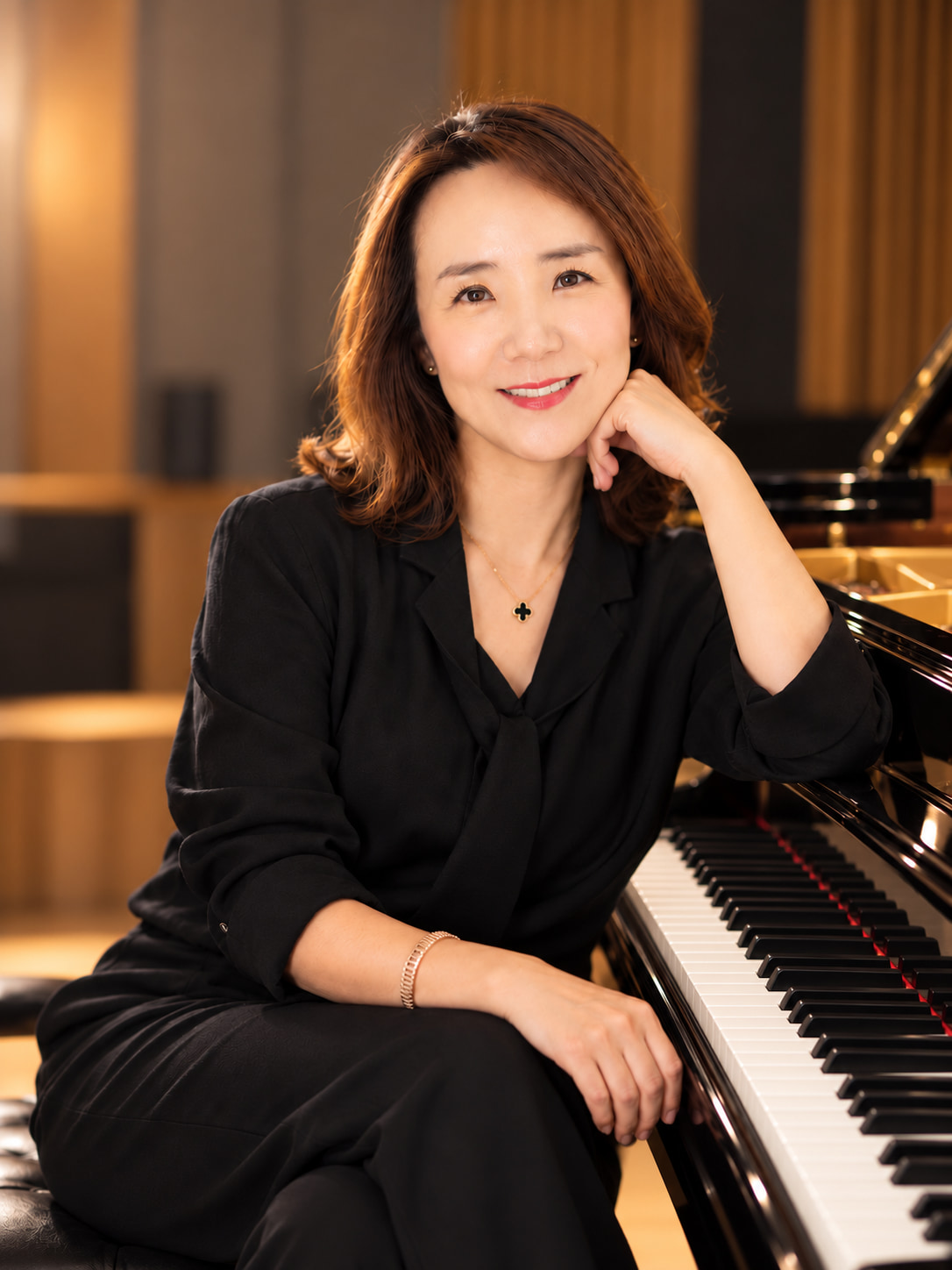
A jazz piano major,with years of accompanying and teaching.
Drawing on jazz, church accompaniment and years of teaching, the teacher builds a foundation at each student’s level. On top of solid reading, students learn to draw a full, rich sound from a page with only melody and chords.
- Jazz piano major, Department of Applied Music, Dongduk Women’s University
- More than 20 years as a church accompanist
- Former director, M&M SOUND Music Academy, Songpa, Seoul
LESSON UPDATES
A note after every lesson,a letter every quarter.
Even without sitting in, you can follow how your child’s music is progressing.
- Weekly note
- After each lessonAfter each lesson, we send a one-page summary of what mattered most. You can see at a glance how the last assignment went, what was covered today and what to practise this week, so you can support your child’s practice at home.
- Last assignment
- Today’s lesson
- For next lesson
- Quarterly letter
- End of Mar, Jun, Sep, DecIf the note records a single week, the letter records three months of growth. It looks back at practice habits, what was learned and what has clearly improved, then shares, from the teacher’s perspective, where the next three months will lead.
- Practice
- This quarter’s lessons
- What improved
- Where we go next
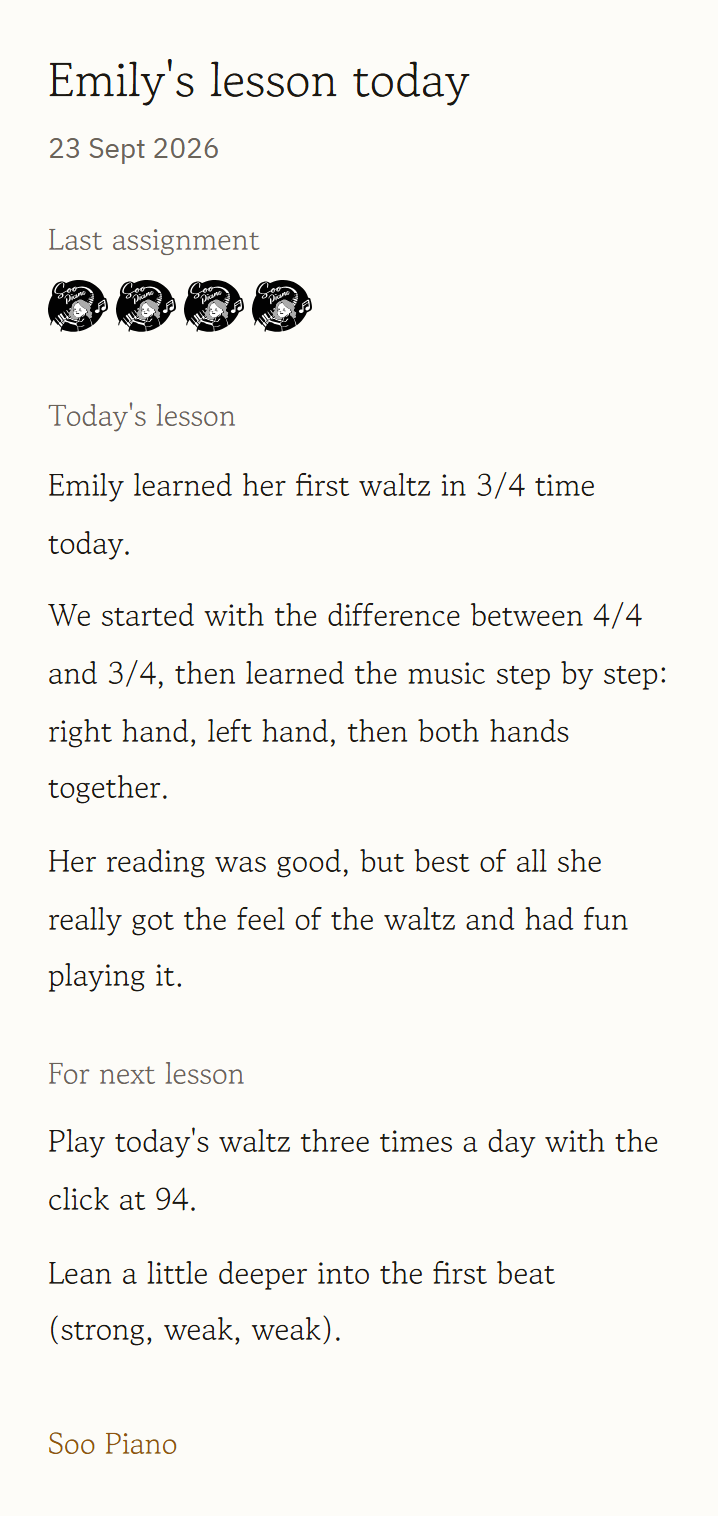
Example weekly note for an invented student, Emily. The last assignment is shown as four Soo Piano logos. Today she learned her first waltz in 3/4, the difference from 4/4, and the music right hand, left hand, then both. For next lesson: the waltz three times a day with the click at 94, leaning deeper into the first beat (strong, weak, weak).
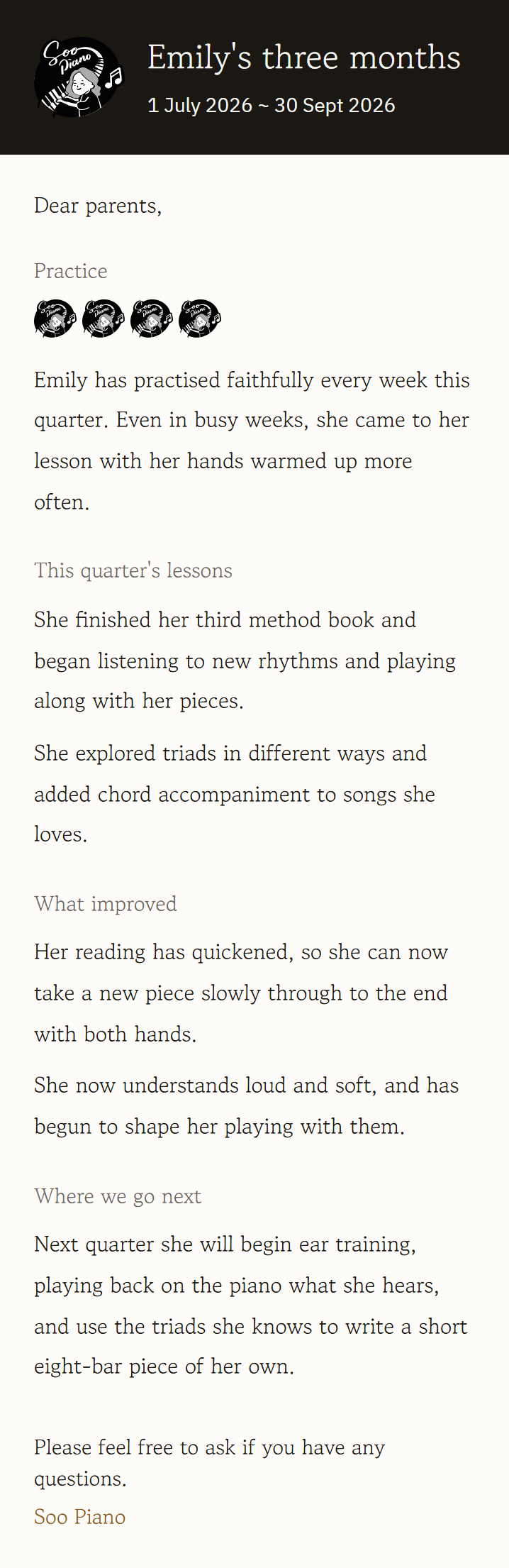
Example quarterly letter for an invented student, Emily. Practice is shown as four Soo Piano logos. This quarter she finished her third method book, began playing along to new rhythms, and worked on triads and chord accompaniment. Her sight-reading and her loud and soft playing improved. Next quarter: ear training and a short eight-bar piece from the triads she knows.
Piano for yourself.Accompaniment for worship.
Starting piano for the first time, returning to a hobby, or chord accompaniment for worship — we connect the fundamentals to real playing at your level and goals.
Questions before you begin.
How does a child new to piano begin lessons?
We first check your child’s current level and piano experience, then build up reading, rhythm and playing fundamentals step by step, guiding them to use what they learn in their own playing.
Can reading fundamentals and favourite songs go together?
We set a direction so the foundation carries into real playing, looking at the songs they love and their current level together to connect the skills and expression they need.
Will AMEB preparation help with chord accompaniment?
The reading and playing skills built through exam preparation help. Chord accompaniment also needs an understanding of chords and real experience applying rhythm and accompaniment patterns, so we discuss the direction to take around their level and goals.
Can my child practise at home if I’m not musical?
Your teacher gives specific guidance on what to practise and how. You don’t need to teach piano yourself — simply encourage your child as they follow it.
Is a trial lesson available?
Yes, trial lessons are available. Please enquire for details such as the format and available times.
Do you teach adults or church accompaniment?
Yes. We teach adults starting or returning to piano, as well as church accompaniment, guided by your current playing and goals. Teenagers are welcome to enquire too.
Location
Dundas Valley, Sydney
Near Dundas Park
So a first piano lessonbecomes joyful playing.
We start from your child’s level and build the foundation together. Adult and worship accompaniment enquiries are welcome too.
Enquiries
- Emailhello@soopiano.com.au
- Phone0437 673 277
The enquiry form couldn’t be loaded. Please reload the page and try again.